
ClubGG Session Boundary Routine: Practical Tips for Club Poker Players
I joined a second club inside the same network about a year after my first, and the thing that struck me wasn’t the game list — it was the rhythm. The host had posted a schedule with fixed start times, a registration cut-off, and a closing time for the night. Because those edges existed, the session ended itself. Nobody had to make a decision at one in the morning.
That’s the idea worth borrowing. Most players treat stopping as a test of character. It isn’t. It’s a design problem, and the people who run clubs and unions have already solved it in the way they publish game lists and schedules. Copy that same thinking onto your own night and a boundary routine stops feeling like a rule you’re arguing with.
Everything below is informational, not legal or gambling advice. Rules and laws around club-based poker apps vary by location, so check what applies where you live, and treat each club’s own rules as the last word.
First, what the host or union has already decided
If you’ve only ever played in one club, it’s easy to assume the app decides everything. It doesn’t. A host running a single club — or an agent coordinating several clubs under a union — makes a set of choices that shape every session on that network. Four of them matter directly to how your night goes.
Game lists and levels
The game list tells you which formats are running, at which game levels, and how many tables of each stay open. A network that standardises that list across its clubs means you can move between rooms without relearning the menu. When the list changes, it’s usually because the host has been watching which tables stayed busy and which went quiet — the same review habit you’re about to apply to your own sessions.
Schedule windows
Start times, late registration cut-offs, and closing times. A club that closes its schedule at a set hour is doing the thing most players can’t do for themselves: writing an ending that doesn’t depend on how the night is going.
Table rules and etiquette
Rules covering table chat, sitting out, how long a player can hold a seat while away, and pace of play. Unions standardise these across their clubs so someone moving between rooms isn’t surprised by the house style. Read the pinned version once a session, not once a lifetime.
The part no host can decide for you
When your attention runs out. Whether you’ve had enough. A schedule can close a table; only you can close your own night while the tables are still running. That gap is what a routine fills.
The four parts of a routine that lasts a whole night
A working routine has four parts. Miss one and you don’t have a plan — you have an intention.
- A start signal. The specific action that opens a session, such as opening ClubGG and confirming the club identifier matches the club you meant to join.
- A check-in. A fixed moment where you pause and decide whether to keep going.
- An exit condition. Something that ends the session whether or not stopping feels convenient.
- A log line. One sentence written afterwards so the routine can actually improve.
Two things a boundary is not: a superstition you perform to change how cards fall, and a punishment for a rough hour. Both of those are about results. A boundary is about the clock.
Decide your numbers before you open a table
Four numbers, all chosen while you’re thinking clearly, all written somewhere you’ll see them.
- Time cap. Be honest about tomorrow. Two hours before an early start isn’t the same commitment as three hours on a free Saturday.
- Table cap. Attention doesn’t stretch. Two tables you’re genuinely reading beats four you’re half-watching.
- Entries at your chosen levels. Pick the game levels you’ll play and how many entries you’re comfortable using, then write the number down. A difficult first hour shouldn’t be allowed to quietly rewrite it.
- Wind-down minutes. Five minutes between ending the session and closing the app — a bit of table chat, a glance at your notes — keeps the ending from feeling abrupt, which is exactly what makes people reopen and start again.
The check-in that actually gets done
A boundary you set once is a boundary you’ll miss. Set a repeating reminder — every 60 minutes if you’re running more than one table, every 90 on a single table — and do the same three things each time.
- Stand up. Movement breaks the hand-after-hand loop that makes time disappear.
- Ask two questions. Am I still playing the way I planned? Is my attention where it was in the first twenty minutes?
- Re-read the cap. Look at the number you actually wrote, then decide: continue on the same plan, or close now. Both answers are allowed.
Keep it short on purpose. Long breaks turn into a different activity; a 90-second reset is something you can repeat all night without resenting it.
Exit conditions that ignore how the night is going
The whole difficulty is that a boundary has to hold when the session is going badly and when it’s going well. So tie your exit to something neutral:
- An alarm set before you join, not one you set once you’re already deep in.
- A set number of hands, counted by the app or ticked off in a note each orbit.
- Attention sliding into autopilot — clicking through the table without reading it.
- Table conditions you didn’t plan for, like a much faster or much slower pace than you expected.
- A technical problem you can’t resolve in a couple of minutes.
None of those depend on how the session is unfolding. “I’ll stop when it turns around” isn’t an exit condition. It’s an open-ended commitment with no clock attached.
A weeknight when it’s actually working
8:40 p.m. I open ClubGG, check the saved club identifier against the club I meant to join, and skim the pinned rules. Nothing has changed since last week.
8:42 p.m. One line goes into my notes: “Two hours, one table, two entries at the levels I picked, out by 10:45.” Alarm set for 10:30 as a warning, another for 10:45 as the hard stop.
9:45 p.m. The hourly reminder fires. I stand up, refill the water glass, and check my attention. Steady, so the plan stands.
10:30 p.m. Warning alarm. I play out the hand in front of me, say goodnight to the table, and close the app. The session ends on the clock, not on how it went.
10:38 p.m. One more line in the same note: “Finished on time. Attention dipped around hour two — try 90 minutes next week.”
That last line is the part that improves. A boundary you never review stays the same size forever, even when your week changes shape.
Where club identifiers, rules and support fit in
Boundaries and club admin overlap more than people expect, and three pieces of admin are worth knowing before you commit to a long evening.
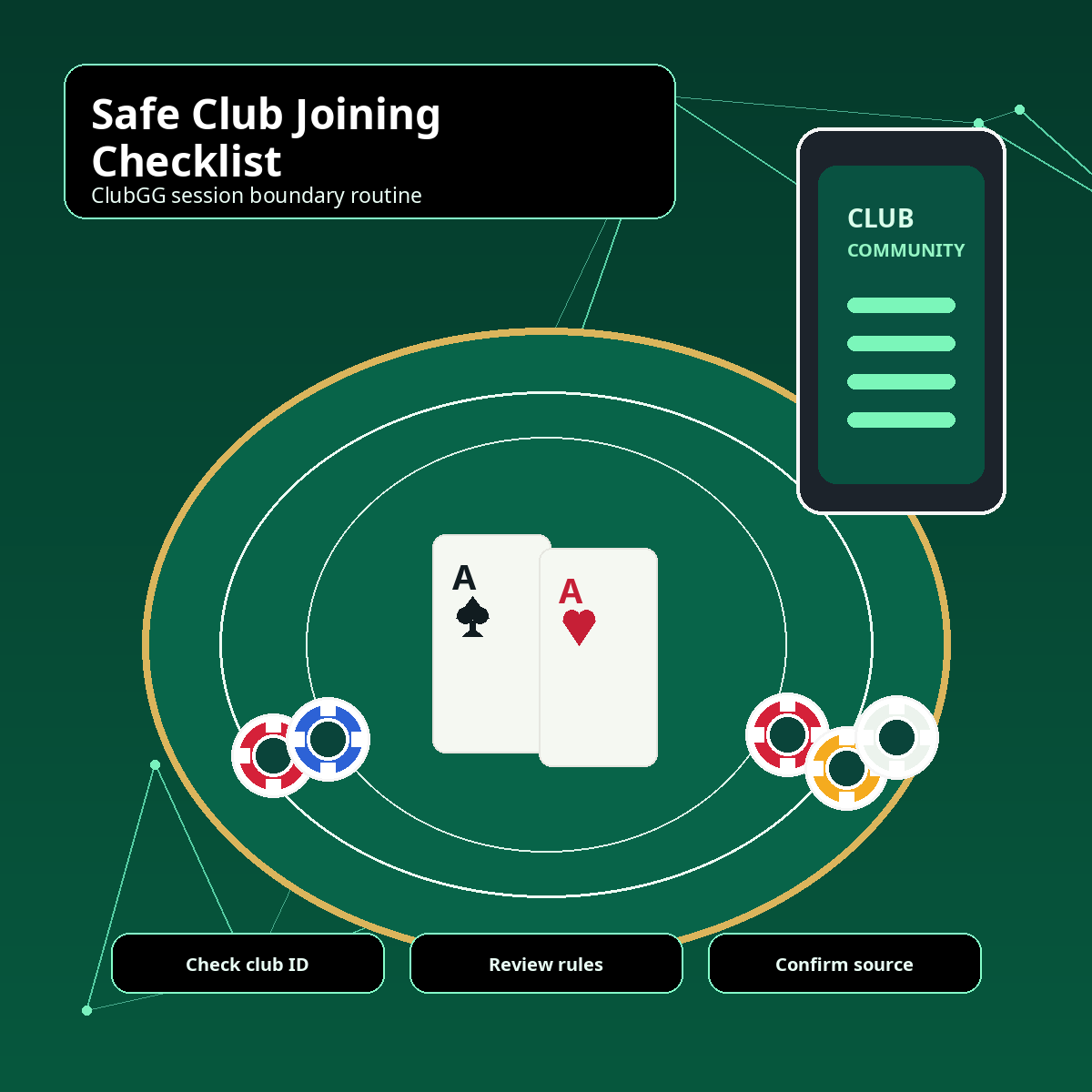
Club identifier. The club ID is how you land in the right room. Save it and check it before joining rather than searching by name — forwarded invites and near-identical club names are where the mix-ups start.
Rules. Clubs run their own tables, schedules and etiquette, so the rules pinned inside the club are what apply to your session. If something reads ambiguously, ask before you sit down instead of interrupting a table to argue about it later.
Support. If access fails, a table misbehaves, or you disagree with how a situation was handled, contact support through the app with the time, the table name and a screenshot. Trying to sort it out in club chat usually makes it worse, and it eats the time you’d set aside for playing.
Three ways the routine quietly comes apart
The one-more-hand extension. One hand becomes one orbit, and one orbit becomes an hour. If you extend, extend by an amount you named in advance — “one more orbit” — and reset the alarm. Improvised extensions are the same as having no cap at all.
The open-ended session. “I’ll play until I’m done” sounds relaxed, but it removes the only mechanism that ends anything. Even a generous three-hour cap protects you better than no cap.
The unlogged session. If you never note when you started, when you stopped, and how your attention held up, you can’t tell whether your cap is too long or too short. One line is enough.
One line per session
- What you planned: time, tables, entries at your chosen game levels.
- When you actually stopped.
- One word for attention — sharp, steady, drifting, gone.
- One adjustment for next time.
Ten of those lines and patterns appear that you genuinely cannot feel in the moment. Plenty of players discover their useful window is shorter than they assumed, or that one particular hour of the night is consistently worse for their focus than they’d have guessed.
FAQ about ClubGG session boundary routines
How long should a ClubGG session run?
Somewhere between 60 and 120 minutes suits most players, because attention tends to slip during the second hour. Your own number depends on your schedule, how many tables you’re running, and what your log tells you — start at 90 minutes on a single table and adjust from there.
Do hosts and unions enforce session boundaries for players?
No. Hosts and unions set game lists, schedule windows and table rules, but they don’t police how long an individual sits. The closing time on a club’s schedule is the closest thing to an enforced edge, which is exactly why your own cap has to come from you.
Does the routine change when I’m running more than one table?
Yes, in one direction: lower the time cap. Two tables you’re reading carefully demand more attention than one, so a 90-minute single-table cap might become 60 minutes across two. Keep the same exit signals, but check in more often.
How do I find a club whose schedule fits the hours I actually play?
Start with a directory rather than the first invite code you’re handed, so you can compare schedules and rule sets before committing to anything. ClubGG clubs are listed at clubggclubs.com/clubgg-clubs, where you can see what’s available and pick one that matches when you’re genuinely free.
Is it a problem if I keep finishing early?
No — finishing early is the routine working. A shorter session with sharp attention tells you something real about your useful window, and noticing that habits shift over a couple of weeks is worth more than forcing a session to run its full length.
The routine is deliberately small, and that’s what makes it hold. One time cap, one table cap, a set number of entries at the levels you chose, one alarm, one line in a note. Laws around club poker apps differ by location, and none of this is legal or gambling advice, so check local rules and your club’s own terms before you play. Then keep the routine small enough that you’ll genuinely run it every single time.