
Your first table inside a ClubGG club usually looks calm. Six or eight names, a decision timer running down, a chat box that stays quiet for long stretches. Then someone spends eleven seconds on a decision that normally takes two, a stranger types “you there?”, and you realise the club has a culture you have not learned yet.
That culture is what this article covers. ClubGG supplies the app and the table mechanics. The people running each club supply everything else: who gets in, how long a decision may take before it is enforced, what counts as bad behaviour, and who to message when a session goes sideways. Understanding both layers is what makes the first week go smoothly instead of awkwardly.
How clubs on ClubGG are actually set up
ClubGG runs on a club identifier model. An organiser creates a club, and the app issues a short club ID — a string of letters and numbers you type or paste to request access. You do not browse a public lobby and sit down at whatever looks interesting. You either have the identifier or you do not get in.
That single design decision shapes almost everything about etiquette. Membership is approved, not automatic. An administrator sees your request, checks it against whatever vetting the club uses, and either accepts it or leaves it sitting unanswered. Once accepted, you appear on a member list that admins can see, along with notes about your history if the club keeps them.
Practically, this means three things worth internalising early:
- Your reputation follows you inside that club. Admins can review who you are and how you have behaved before you ever sit at a table again.
- Rules are local. Two clubs running the same games can have completely different tolerance for table talk, slow decisions, or late arrivals.
- Leaving is easy, and rejoining may not be. If you exit on bad terms, a rejected request later on is a real possibility.
The written rules almost every club posts
Most clubs publish a rule sheet in an announcement channel, a pinned message, or a document linked from the club description. The wording changes from group to group, but the same handful of items appear again and again.
Decision time. Nearly every club sets a clock per decision and a shorter clock before the flop. Running it down repeatedly reads as a delay tactic even when you genuinely have a close decision. A workable compromise: play faster in early positions and take your longer pause only when the hand is genuinely contested.
Seating and leaving. Clubs generally ask you to give notice before standing up from a table, and they penalise players who join, play one hand, and vanish. The phrase you will see is “no hit-and-run” — it is not about the result of the hand, it is about the disruption to a table that then has to hunt for a replacement.
Chat conduct. Rules here are stricter than newcomers expect. Insults, baiting, discussing a hand still in progress, and commenting on how someone else played are all commonly listed. Many clubs mute first and explain afterwards.
Account honesty. One account per person is standard. Sharing an account, playing under someone else’s name, or having a friend take over mid-session is a removal-level offence at most clubs.
Technical honesty. Using outside software, a second device, or any tool that suggests decisions is banned everywhere. Deliberate disconnection to avoid a tough decision is treated the same way.
Attendance expectations. Some clubs require a minimum number of sessions per month to keep membership active. Others do not care at all. Check before you assume, because a silent rule is still a rule.
Etiquette that never makes it into the written rules
The posted sheet covers maybe half of what actually receive you a good or bad reputation. The rest is unspoken, and it is where new members most often stumble.
Do not coach the table
Explaining why a play was correct, or incorrect, is unwelcome even when you are right and even when the hand is long finished. It changes how people play against you and it turns the table into a lesson. Stay quiet. If you must talk, talk about anything else.
Keep the chat human, not tactical
“Nice hand” is fine. “You had to call there” is not. The distinction is simple: does your message reveal information about a hand, live or finished?
Slow-rolling is a real offence
Holding a strong hand back to let someone else act first, purely for effect, is the fastest way to receive a lasting reputation. Most clubs will not write it down, but admins notice and members remember.
Do not lobby for rule changes mid-session
If a rule bothers you, message an admin between sessions. Raising it in the table chat while it is being applied to you reads as pressure rather than feedback, and it rarely ends well for the person raising it.
Say goodbye when you leave
A one-line “thanks, good game” costs nothing and gets noticed. Silent exits after a short session are exactly what the no hit-and-run rule exists to discourage.
Who enforces what, and where support fits in
Members often blur two very different things: app-level problems and club-level problems. Getting them straight saves a lot of frustration.
Club administrators handle membership, seating, table conduct, muting, and removal. Their decisions are internal to the club and cannot be appealed through the app.
ClubGG support handles account access problems, app errors, a table that will not load, a stuck hand, or a technical fault that affected a session. Support does not overrule an admin’s judgement about your behaviour, and it will not rewrite a club’s rules for you.
You handle the part that matters most: reading the rules before you join, keeping a note of anything unusual, and raising problems through the right channel instead of in table chat.
When a session goes wrong, note the time, the table, and the players involved. A short factual message to an admin is far more effective than a paragraph of frustration typed into the chat box. If the problem is technical rather than social, send the same details to support inside the app and keep the reply thread going until it is resolved.
Reading a club’s rule sheet before you join
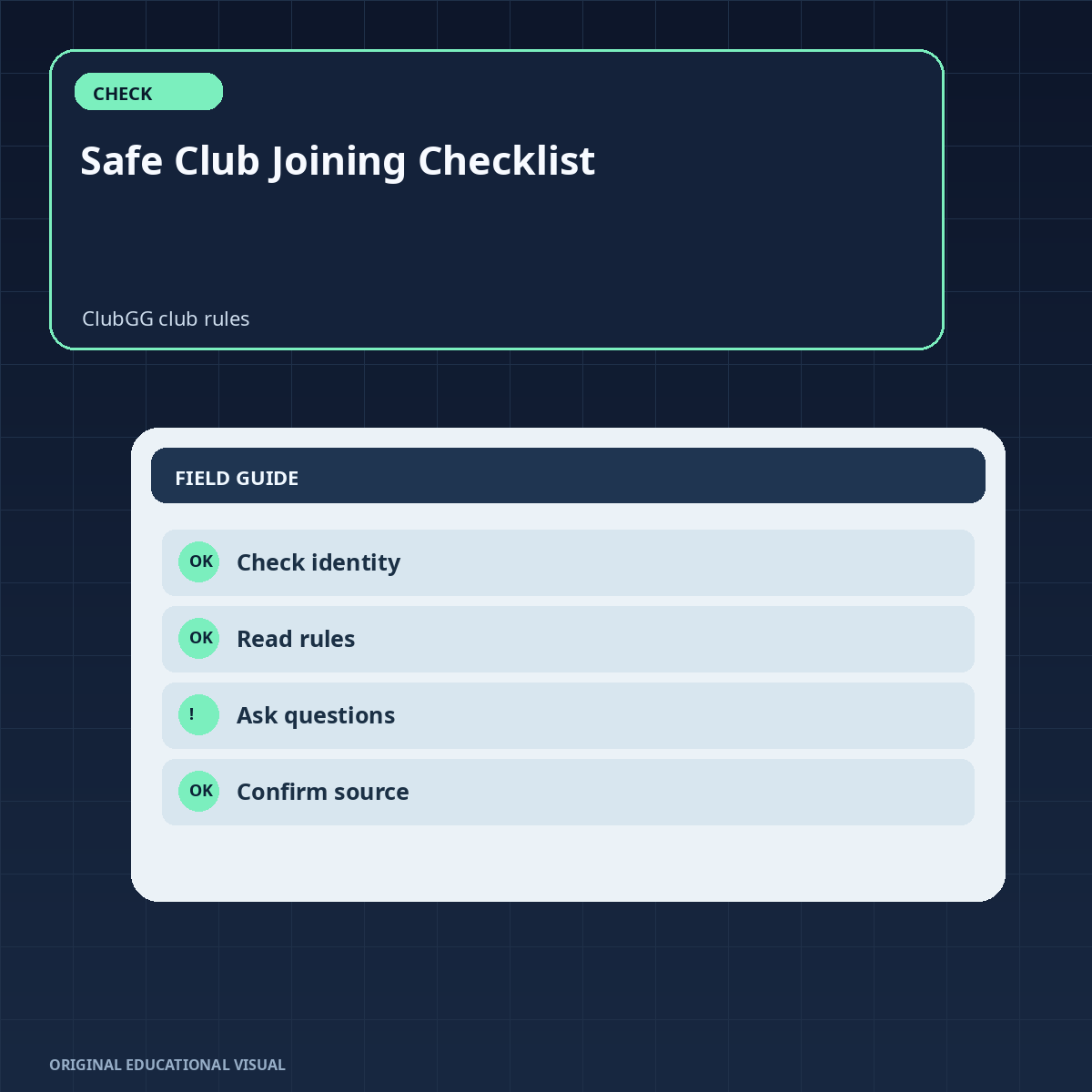
Do not accept an invite and start playing in the same minute. Spend ten minutes on the following instead, and you will know exactly what you are walking into.
- Find the rule sheet. It is usually pinned, announced, or linked from the club profile. If there is no rule sheet anywhere, treat that absence as information about how the club is run.
- Check the decision clock. If it is short and you like to think, you will be out of place, and both you and the table will feel it.
- Read the removal policy. Some clubs remove on a first offence; others issue a warning and a second chance. Know which one you joined.
- Look at activity levels. A club with a busy announcement channel and regular updates is usually run by people who are paying attention.
- Confirm how to reach an admin. If the only contact route is a public chat, keep that in mind for the moment something private comes up.
- Check the region and the local law. Rules around social card games differ widely between countries and even between states within one country. Laws vary by location, and nothing in this article is legal or gambling advice.
Your first week: habits that keep you welcome
New members tend to make the same few mistakes. Arriving with a name nobody recognises, staying silent for an entire session, then leaving abruptly is a poor introduction even if you played well. A better pattern is boring and effective.
- Introduce yourself in the club chat once. One line is enough.
- Play a few shorter sessions before settling in for a long one. People notice regulars.
- Use the decision clock honestly. If you need the full timer, take it; if you do not, act.
- Keep any dispute out of the table. Admins resolve disputes; players escalate them.
- If you are unsure about a rule, ask an admin before the situation comes up, not during it.
- Leave a short message when you go, especially after a brief session.
None of this is complicated. The members who get removed from clubs are rarely removed for playing badly. They are removed for making the table unpleasant or for ignoring a rule they had clearly been told about.
Where you join matters more than the rules on paper
Two clubs can post nearly identical rule sheets and still feel completely different to play in. One has admins who respond within minutes and a chat that stays friendly. The other has a rule sheet nobody reads and a table where arguments run longer than the hands. The written rules set a floor; the people running the club set the ceiling.
If you are still deciding where to request access, compare how different groups run their tables rather than looking for the busiest one. A directory of active groups is a reasonable starting point — the ClubGG clubs directory lists communities you can review before you send a club identifier request anywhere.
FAQ about ClubGG club rules and etiquette
How do I find a club’s rules after I have joined?
Look in three places, in order: the pinned messages in the club chat, the most recent announcement, and any document linked from the club description. If none of them contain a rule sheet, message an admin directly and ask for the rules in writing.
Can a club remove me without giving a reason?
Yes, in most cases. Membership is granted by the organiser rather than by the app, so removal sits with the same people who approved you. Some clubs commit to warning first and others do not, which is exactly why reading the removal policy before joining is worth the two minutes.
What should I do if another player breaks a rule during a hand?
Finish the hand, then report it privately to an admin with the table name, the time, and a plain description of what happened. Do not correct the player in the chat, because that usually creates a second problem the admin then has to untangle as well.
Does ClubGG support decide what a club’s rules are?
No. Support deals with app errors, access problems, and technical faults, while each club writes and enforces its own conduct rules. That split matters when you are deciding who to contact about a specific problem.
Are club rules the same everywhere?
No. Rules vary between clubs, and the legal position on social card games varies between countries and regions. Laws differ by location, so check what applies where you are; this article is general information rather than legal advice.
What happens if I think an admin’s decision was unfair?
You can send a calm, factual message to the club owner or a second admin, and that is the end of the formal route. There is no external appeal, because the club is a private group and its organisers decide who belongs in it.
Join a club the way you would join any small group: read what they have written down, watch how people behave for a session or two, and match the room before you try to change it. The rules on the sheet tell you what the club will enforce. The etiquette you pick up in your first week tells you what the club actually values — and that is the part that decides whether you are still there in six months.