
ClubGG vs GGPoker: How the Club App Relates to the Main Site
The first time I joined a second club, I opened the app expecting the lobby I already knew from the main site. It was not there. No network-wide table list, no platform schedule, nothing I could browse as a stranger. What I got instead was one group’s tables, run by people I had never met, governed by a page of house rules I had not read yet. That absence is the whole of the ClubGG vs GGPoker question: one software family, two very different front doors — and behind the club door, a layer of people making decisions.
One note before anything else. Rules and laws around online poker vary by location, and this article is informational only. It is not legal or gambling advice, and it is no substitute for checking what applies where you are.
One network, two ways in
GGPoker is the main platform. You register with the operator directly, sign in on the site or its own app, and browse a lobby the platform controls. Your account lives with the operator from your first session onward, and nobody has to approve you before you can look around.
ClubGG is a club-based app built on that same network. There is no public lobby to wander into. You install the app, then join one or more groups using a club ID — sometimes written as club identifier — handed out by whoever runs the group. Access runs through the club rather than through a front door.
Almost everything else follows from that. On the main site, the platform decides what exists and shows it to everyone at once. Inside a club, a person decides what exists, and shows it to members.
What a club ID is, and what it is not
A club ID identifies a group. It is not a login, not a password, and not a credential of any kind. Passing it to a friend does not expose your account; guarding it does not protect anything either. What it does is tell the app which club’s table list to show you once the organisers on the other end accept you.
Some clubs will take anyone who asks. Others are closed circles — a group of friends, a local community, a set of regulars who have played together for years. Membership of one does not make you a member of another, even inside the same app, and stepping away from a club ends your access to that club’s tables rather than your ability to join a different group later.
If you want to see how these groups are organised before approaching one, the overview of ClubGG clubs covers how membership and club-level structure usually work.
The layer that actually decides your evening: hosts and unions
Here is the part I wish someone had walked me through early. Inside ClubGG, the software is the easy bit. The decisions that shape your session come from two kinds of people.
Hosts run individual clubs, setting the game list, the weekly rhythm, the house rules, and the tone of the room. Unions are groups of clubs that agree to share a table pool, so a quiet club can draw on its neighbours and a busy one can spread the load.
When I ask a host what eats their week, the answer is rarely technical. It is aligning a schedule with the other clubs in the union. It is agreeing how a disconnection is handled, so that two clubs do not resolve the same situation in opposite ways. It is deciding which game levels run in the shared pool and which stay club-only. It is settling what happens when two members read a hand differently. Multiply that across every club in a union and you have a small standards problem — the same work a platform does centrally, done by people in a group chat.
Two clubs can run the same game and still feel nothing alike, because the details drift. How long is a seat held after a dropped connection? Is late entry allowed, and until when? Who is the first point of contact when something looks wrong at the table? Hosts who write those answers down and hold to them keep their players. Hosts who improvise watch them drift — and inside a union, one club’s improvisation becomes another club’s problem.
Who decides what runs
There are three layers to the game list, and mixing them up causes a lot of confusion.
- The platform builds the menu — the formats, variants, and tournament structures that exist at all.
- The host chooses the slice that actually runs at their tables, and at which game levels.
- The union decides what is shared across member clubs, so several groups can draw on one pool instead of each running a thin game alone.
That is why two players on the same app — one in a small standalone club, one inside a large union — can have completely different experiences of the same product. Nothing about the software changed. The people deciding changed. Ring games, tournaments, and the game levels they run at are all set somewhere along that chain rather than by a menu anybody can browse.
Schedules come from the club, not the lobby
On the main site, the platform publishes a schedule and everyone sees it. Inside a club, the rhythm belongs to the group: a league night on a fixed weekday, a rotating host each evening, quiet mornings, busier weekends. Some of that rhythm is inherited from the union, since shared tables need shared start times to be worth pooling.
So ask a host straight out what the busy hours are. A club that peaks while you are asleep is not much use, however well it is run.
Two rulebooks, and sometimes three
- Platform rules. Account integrity, verification, prohibited software, general conduct. They apply anywhere the network’s software runs, and nothing below them can override them.
- Union rules. Shared table etiquette, how a disagreement is escalated between clubs, how disconnections are handled in a pooled game.
- Club rules. The daily detail: how disputes are raised, how long a seat is held, who decides what happens next.
Club rules sit underneath union rules, which sit underneath platform rules. But the bottom layer is usually the one that decides how your evening actually goes, so read it when you join rather than after a disagreement.
Where to take a problem
This is where newer members most often look in the wrong place. When a table will not load, a connection drops at an awkward moment, or two players disagree, the first stop is normally the club’s own organisers. They run the tables, they know the schedule, and they know who was sitting where.
If the issue clearly crosses clubs — a shared table misbehaving for everyone, a dispute involving members of two groups — the union is the layer that handles it. Platform support still matters for account and software questions that sit above the club structure entirely.
On the main site there is only one route: the operator, with no middle layer and nobody who knows your usual table.
Accounts and verification
- A main-site account is created by you, directly, with the operator.
- A ClubGG seat is granted by a club after you supply its club ID.
- Membership of one club does not extend to another, even inside the same app.
- Verification can appear on both sides for the same reasons: age checks, region checks, and preventing one person from holding duplicate accounts.
Expect to supply similar documentation twice if you use both products. That is not a flaw in either one; it is two organisations satisfying their own checks.
How I judge whether a club is well run
- A written set of rules you can read before your first table, not after.
- A named contact or moderator who answers questions within a reasonable window.
- A clear route for disagreements, and a sense of how long that route normally takes.
- A schedule that matches the hours you actually want to play.
- Sensible behaviour around game levels — a host who nudges members upward quickly is not doing anyone a favour.
- Some sign that the club talks to its union, so shared tables behave consistently.
None of that needs technical knowledge. It is mostly a matter of reading what a group publishes and noticing what it leaves out.
Before you take a seat at a new club
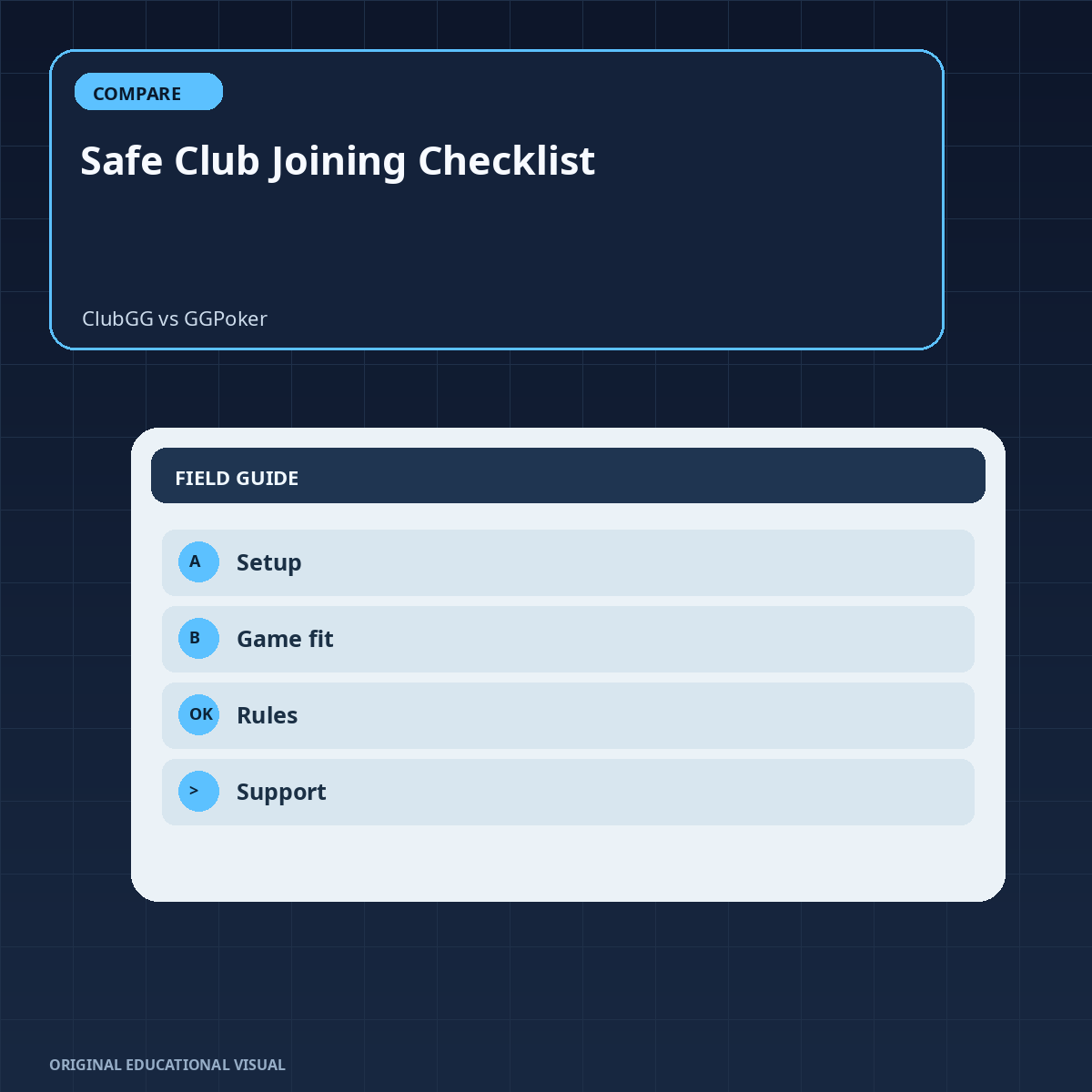
- Confirm the activity is lawful where you are. Responsibility for that sits with you.
- Read the rules — platform rules on the main site, and club plus union rules inside ClubGG.
- Find out who you contact first if something goes wrong, and how quickly they usually reply.
- Check age and verification requirements on both sides before you plan an evening around playing.
- Set a session budget and a time limit in advance, and treat both as fixed.
- Keep your account details private, and remember a club ID is not one of them.
Slip-ups that catch new members
Treating a club ID as a password. It is not a login. It identifies a group, and sharing it does not put your account at risk.
Expecting the operator to referee a club argument. Platform support handles account and software matters. It generally does not settle a hand between two members of a private group — that is what club and union rules exist for.
Assuming club rules are optional. They are the terms you accepted when you joined, and ignoring them usually ends with a removed seat.
Joining three clubs at once to compare. Reasonable in theory, but every group has its own schedule and its own etiquette. Spread thin, you belong properly to none of them.
Frequently asked questions about ClubGG and GGPoker
Is ClubGG a separate operator from GGPoker?
No. ClubGG is a club-based app on the GGPoker network — connected to it and sharing the same software family, but structured as a club product rather than as the operator’s main platform. The two share technology and infrastructure while offering different ways in.
Can I reach ClubGG tables without a club ID?
No. Access runs through a club, and you cannot join one without its identifier. Organisers hand these out directly, through community pages, or through directories that list groups. Without one, the app has no table list to show you.
Does my main-site login work inside a club?
Not as a membership. A main-site account is created with the operator, while a ClubGG seat is granted by a club after you supply its identifier, so the membership does not carry across even where your personal details overlap.
Who do I ask when a club table will not load?
Start with your club’s organisers, because they run the tables and know the local schedule. If the problem looks like a wider software or account issue rather than one club’s table, platform support is the right channel. Note the table, the hand, and the time before you write — specifics get answered far faster than a general description.
What is a union, and does it matter which one my club belongs to?
A union is a group of clubs that share a table pool, and it matters a great deal. A club inside a busy union can offer games across far more hours than the same club could run alone, because other groups feed the same tables. The trade is that some rules and start times are agreed at union level rather than by your host, which is exactly why it is worth asking which union a club belongs to before you settle in.
ClubGG and GGPoker are related products doing different jobs. One is an open platform with a single front door and a single support route; the other is a club layer riding on the same network, where hosts and unions decide what runs, when, and under whose rules. Knowing which one you are actually sitting inside makes everything downstream — joining, scheduling, and getting help — far less confusing. This article is informational and is not legal or gambling advice.